Thursday, May 5, 2011

Salesforce Financials Revisited

It has been over two years since I looked at the financials of salesforce.com so I thought is was well overdue. To recap on previous analysis here are the links:

http://leontribe.blogspot.com/2008/09/valuing-salesforcecom-and-its.html

http://leontribe.blogspot.com/2009/02/salesforcecom-revisited-still.html

In September 2008 the price of salesforce (CRM) was $58.00 and the price of Microsoft (MSFT) was $27.34

In February 2009 the price of salesforce was $28.00 and the price of Microsoft was $16.15

As of today (4 May 2011) salesforce is $133.66 and the price of Microsoft is $25.81

I make no bones about the fact that my opinion is that the share price of salesforce is expensive for what it is. However, as can be seen, the market disagrees with me and that is why I am in IT and not retired on a luxury yacht sailing around the Bahamas. This is also why you should get financial advice from a licensed professional and not necessarily listen to the opinions of a CRM consultant. To be fair I am not the only one who is pessimistic on the prosperity of salesforce’ share price (http://seekingalpha.com/article/264023-how-salesforce-com-could-get-crushed-this-quarter, http://online.wsj.com/article/SB10001424052748704150604576166280156761902.html#articleTabs%3Darticle)

That being said, how are the fundamentals of the business going?

Subscription Numbers

I recently came across a little treasure known as the detailed salesforce financials (http://bit.ly/fJyolc). The last page has all the subscription numbers ever released by salesforce, including confirmation that the number of users (subscribers) has not been released since the end of 2007 (at least not to an accuracy greater than to the nearest million).

After a bit of digging, the conclusion I have come up with is this is no longer released because it covers all of salesforce’s products e.g. Chatter, force.com, Sales Cloud, Service Cloud etc. Therefore a strict comparison of numbers against, say, the subscriber numbers of Dynamics CRM is not valid as it is one Microsoft product versus the entire suite of salesforce products. To make the comparison meaningful, we need to assume that the majority of the subscriptions salesforce has is with the sales product, which may not be true.

One interesting note to be made is that if we look at the subscription and support revenue per subscriber and customer a clear trend emerges. That is, while the number of people at a customer site using salesforce products is increasing, the revenue from each one is, on average, decreasing and the overall result is the revenue from each customer is relatively flat.

Quarter Customers Subscribers Average Customer Size Revenue Revenue Per Subscriber Revenue Per Customer
Q2 FY08 35,300 800,000 22.7 $159,998 $200 $4,500
Q4 FY08 41,000 1,100,000 26.8 $196,517 $179 $4,800
Q4 FY09 55,400 1,500,000 27.1 $266,110 $177 $4,800
Q3 FY10 67,900 2,000,000 29.5 $306,870 $153 $4,500
Q4 FY11 92,300 3,000,000 32.5 $428,534 $143 $4,600

This would support the hypothesis that salesforce customers are bringing additional staff on to salesforce products but onto products with a smaller monthly price tag e.g. Chatter. If salesforce ever release subscription numbers for individual products we will have a better idea if this hypothesis is valid. The alternative hypothesis is that customers are downgrading their services i.e. moving from Sales Cloud Professional down to Sales Cloud Group, which I think would be unlikely.

Looking at the last two lines is interesting. In Q3 FY10, the average customer had 30 staff each spending $153 per user per quarter. In Q4 FY11, they added 3 subscribers but the average went down to $143 per user per quarter. This is consistent with simply adding three paying Chatter subscribers to the average customer and the same mix being true for new customers. To put it another way: the growth in the last twelve months can be explained simply by the upsell of Chatter subscriptions and the signing up of new customers. The model suggests that there has been minimal upsell of additional Sales/Service Cloud subscriptions to existing clients. It also suggests around 25% of the million additional subscribers between Q3 FY10 and Q4 FY11 are Chatter subscribers.

For a comparison of how these numbers compare to Dynamics CRM, check out my upcoming presentation at  Decisions Spring 2011. click here to register:

spring_template_header_01

P/E Ratio

The P/E Ratio, at a given point in time indicates the number of years a share will earn back its price. Historically, if you held salesforce shares it would be your children, grandchildren or their descendants that would see the doubling or your investment. In 2008 the P/E ratio was 200 according to MSN Money. In 2009 this improved to 100. Today, according to MSN money, the P/E ration is 280.

So if nothing changes, it will take 280 years for a share buyer to get back the price in dividends or asset accumulation. Something has to change i.e. the ‘P’ or the ‘E’. ‘P’ is the price. for the ratio to come down to a ‘normal’ level, this would have to crash to about 1/20 of its current value i.e. $6-7 . The other option is a dramatic increase in ‘E’, the earnings (or profits). For comparison, the P/E of Microsoft is 10.

Revenue Growth

From 2005-2009, there was a clear pattern in the revenue growth of salesforce. This pattern being a deceleration in the growth (84%, 76%, 60%, 51%, 44% revenue growth respectively) of around 10% reduction in growth per year. In 2010, the revenue growth dropped more sharply to 21% but recovered to maintain the pattern in 2011 with a growth rate of 27%. It will be interesting to see if the growth rate drops below 20% in January next year.

Not surprisingly Microsoft’s revenue growth rate is much smaller than salesforce’s and in fact was negative in FY2010.

Margins

Salesforce has been dogged by small profit margins for years. Between 2005-2009 the profit margins were 4%, 5%, 9%, 3%, 6%, 8%. Salesforce managed to break into double-digits in 2010 with a margin of 11% but has dropped back again to 6% in 2011.

As a comparison, margins at Microsoft have sat around the 30-40% range for over five years.

Sustainable Growth Rate

This is the rate at which a company can grow its revenues without borrowing or issuing shares. This currently sits at 9%, well below their revenue growth rate of 27% meaning more borrowing or share issuing is on the cards.

Microsoft’s sustainable growth rate is, according to my calculations, around 23%, well below their current revenue growth rate of 7%.

Conclusions

Salesforce still has strong customer growth and subscriber growth but it is maintained through the collection of new customers and the upsell of low-value products. Obtaining new customers is an expensive exercise, compared to upselling existing customers and, with margins as low as they are, it may be time for salesforce to shift gears in this regard. It is true they appear to be upselling products like Chatter but really they should be looking to transition customers to the high-end Sales and Service cloud products. The numbers suggest this is not yet happening.

It terms of the P/E ratio it is the same old story. Conventional wisdom would suggest the P/E ratio is very high, meaning the market is very optimistic for the future of the product. It is not clear to me how the earnings are going to grow to such a level as to justify this optimism.

Revenue growth is, and always has been strong but is slowing. However, the growth is still larger than what the business can support meaning it will continue to raise debt and shares for at least a couple of years or until the banks and investors politely decline the opportunity.

My prediction is, with the strong push from Dynamics CRM in terms of pricing and incentive deals, the next quarter’s announcement on May 20 will show an impact on growth. This will frighten the market and we will again see the shares dip below $100. However, do not see this as advice. Benjamin Graham, the man that taught Warren Buffett everything he knows famously said “"In the short run the market is a voting machine. In the long run it's a weighing machine." What Benjamin did not tell us is how long a short run is. Based on the last four years, longer than I expected.

Sunday, April 24, 2011

The Decade of CRM Stagnation at Sage

My blog this week is prompted by a claim I saw in a private group. The author, Jason Carter, suggested that, effectively, Sage had done nothing to grow the ACT! and SalesLogix businesses since acquiring the products about ten years ago. This sounded incredulous so I thought I would look at the numbers.

Interact Commerce in the Year 2000

Interact had two flagship products: ACT! (a contact management solution) and its big brother SalesLogix (a small to medium-sized CRM solution). The dot-com bubble was about to burst (http://en.wikipedia.org/wiki/Dot-com_bubble) and a review of their annual report at the time confirms things were troubled. For those of you that want to comb through the details, here is the link (http://www.sec.gov/Archives/edgar/data/1027108/000095015301500160/p64748e10-k.htm). Here are some of the highlights:

  • Revenues: $108m (2000), $36m (1999), $16m (1998)
  • Total Operating Expenses: $126m (2000), $35m (1999), $18m (1998)
  • Net Loss: $57m (2000), $8m (1999), $7m (1998)
  • Cash used in operating activities: $17m (2000), $3m (1999), $5m (1998)
  • Research and Development: $25m (2000), $7m (1999), $4m (1998) (let’s say about 20-25% of revenue)

In 1999 and 1998 Interact had issued stock and borrowed money to keep the cash flowing in. In 2000 they did not do this and burned through $49m in cash.

So while revenues were indeed increasing at an incredible rate (two-fold between 1998 and 1999 and three-fold between 1999 and 2000), operating expenses were in lock-step and profits were nowhere to be seen. Similarly, the business was failing to generate cash from sales and was propping things up through shares and debt.

Sage in the Year 2010

Sage acquired Interact Commerce in 2001. Along with the acquisition of ACCPAC CRM in 2004, ACT! and SalesLogix make up the stable of CRM offerings in the Sage product mix.

Reviewing Sage’s latest annual report we discover that 4% of Sage’s revenue came from their CRM products (http://ar2010.sage.com/whatwedo.asp)

image

Diving into the numbers (http://ar2010.sage.com/Consolidated-income-statement.asp) we discover that the revenue for 2010 was 1,435.0 million pounds. Taking an exchange rate of 1.6 pounds to one US dollar (the rate around the end of 2010), this translates to around $2,300m in total revenue. 4% of this is about $92m.

So the revenue for the CRM products has gone from around $110m to $90m in ten years i.e. it has not changed significantly and may have actually shrunk. Also note this also includes the, assumed, additional profits of Sage CRM (ACCPAC CRM).

The big difference in the two financial reports is in their health. Although the Sage annual report only talks about the business as a whole, not just the CRM component, Sage is profitable and generating healthy cash flows i.e. they are generating cash from their operations.

Research has also suffered in the name of a healthier bottom line. According to the full annual report, Sage spent a total of 158.9 million pounds on research and development. This is around 11% of revenue, about half what Interact felt they had to invest, as a percentage of revenue, to stay on top.

The Current Popularity of Sage’s CRM products

Back in July of last year, I used Google Trends to see how Dynamics CRM is travelling relative to Salesforce (http://leontribe.blogspot.com/2010/07/using-google-trends-to-predict-crm.html). As an aside, if you want to see an up to date and expanded version of my Salesforce vs Dynamics CRM blog, I will be presenting precisely this at the upcoming Decisions Spring 2011 (http://decisions.msdynamicsworld.com/session/microsoft-dynamics-crm-vs-salesforce-main-event).

We can now use the same technique to review the popularity of the Sage suite of products relative to, say Dynamics CRM.

image

Using Dynamics CRM as a comparison, it is clear that the Sage CRM products are not generating as much interest as Dynamics CRM. Also, it is amazing how far ACT! has dropped since seven years ago.

Conclusions

Sage has not grown their CRM business and has remained effectively stagnant for the last ten years. Moreover, they have cut back research dollars, relative to revenue. In its time, SalesLogix was at the top of the mid-market CRM players. So much so that when Dynamics CRM was first released, the ROI tools provided to Microsoft partners mentioned only two CRM products: Dynamics CRM and SalesLogix. Back in 2003-2004, SalesLogix was to Dynamics CRM what salesforce.com is today.

What is not clear is whether Sage’s stagnation is due to transforming the financials to health or plain old neglect. Either way, products such as Dynamics CRM have now taken the place in people’s minds when they think of CRM and, given the lack of investment in research it is difficult to see how Sage can recover from this position to regain former glory.

Friday, April 15, 2011

Forrester Trajectories of CRM Solutions

I was watching Hans Rosling the other day do what he does best with his gapminder software. That is, dispelling myths and making volumes of data speak volumes through visualisation. If you don’t know Hans, here is an example of him at work.

Hans Rosling and gapminder

It occurred to me that the little dancing circles were not dissimilar to the Gartner quadrant and Forrester Wave pictures those of us in the IT game are used to. I figured that while I did not have a few hundred years of data, even with a few years of information I may be able to extract some interesting conclusions.

If you are interested in seeing the research, a good place to begin is the Microsoft Analyst Relations Reports. Here you will find a host of white papers and reports. Obviously, Microsoft are unlikely to link to reports which paint their products in a poor light so feel free to use your favourite search engine to supplement.

While Gartner reports were a little light on the ground, I did manage to find a good selection of Forrester Wave reports for CRM suites in the mid-market and enterprise-market on the Microsoft page and supplemented this with another I found online (http://www.ibizinitiatives.com/ForresterCRMStudy.pdf)

Mid-market Velocities

imageimageimage

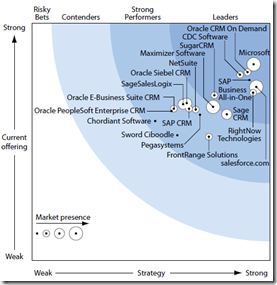
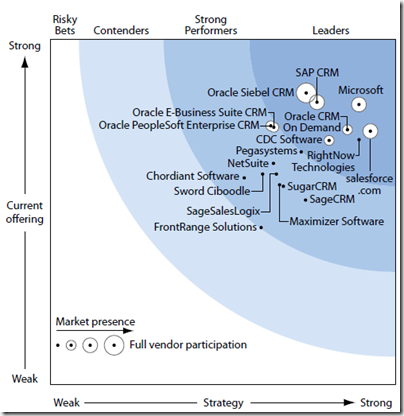
These three graphs are for 2007, 2008 and 2010 respectively. The size of the circle, if I am reading the paper correctly, is a rough measure of market share and the company’s dedicated team size to the space.

The first thing I notice is the migration to the top right corner; the leaders area. Overall, solutions are generally improving.

In terms of individual products, let’s look at some of the more interesting ones.

Solution Observations
Oracle Siebel CRM Professional This one appears to be slipping. The product to be envied in 2007-2008, they are now truly out of the Leader section, falling back to Strong Performers. Strangely, they appear to have a stronger market presence now than in the past.
salesforce.com The ‘cloud Siebel’ continues to improve their product and appears to have increased their market presence in recent years
Microsoft Dynamics CRM Like salesforce.com, Dynamics CRM continues to advance towards the top right corner, it has increased its market presence and is now the leader on the chart.
Netsuite Although the movement is not huge, it does appear to be moving in the wrong direction.
Sage Saleslogix Appears to be advancing through the Strong Performers but is yet to make a Leaders position
CDC Software’s Pivotal Despite not featuring in the 2008 chart, they have rocketed from a Contender position through to Leader.
SugarCRM Another little battler. The have moved through to a Leader position and have improved their market presence
Sage CRM Also increasing market presence and is just in the Leader position
FrontRange’s Goldmine Their market presence has gone from one of the two dominant players to one of the smallest in a span on three years.
Maximizer Goldmine’s fortunes are contrasted against the other ‘big player’ in 2007, Maximizer. Maximizer has maintained its market presence and is also now in a Leader position


Enterprise Velocities

For the Forrester Wave reports, I could only find reports for 2008 and 2010

imageimage

However, there are still things to observe. For example, it appears that a lot more of the, traditionally, smaller market players are now stretching into the enterprise.

As for individual products, there are also some things of note.

Solution Observations
Oracle Siebel CRM The traditional ‘900-pound gorilla’ in the market, their strategy appears to be slipping and other players stretch up from the mid-market. They have lost their dominant position but remain a Leader.
SAP CRM Suffering a similar fate to Oracle Siebel CRM, SAP also has the indignity of reducing its market presence.
Microsoft Creeping up, they have now taken the dominant Leader position in the market
salesforce.com Similar to Dynamics CRM, salesforce.com appears to also be sliding in front of Oracle Siebel CRM and SAP CRM
Oracle Peoplesoft CRM Loss of market presence and also appears to be moving in the wrong direction, albeit slowly.
Oracle E-Business Suite CRM Also losing presence and moving in the wrong direction.


Conclusions

For those of us that remember Mosaic, MySpace and WordPerfect, we know that today’s darling is tomorrow’s forgotten software. There are some clear trends here:

  • Oracle cannot seem to do anything right. Their products, which they have many, are either stagnating or going backwards, relative to their competitors
  • salesforce.com and Microsoft Dynamics CRM are edging out the competition in both the mid-market and enterprise
  • Players such as CDC Software’s Pivotal, SugarCRM and Sage CRM should be watched, given their trajectory

As other Wave reports come out I will update the research.

Disclaimer: As well as working extensively with Dynamics CRM, the company I work for, Praxa, is owned by the same company as CDC software.

Sunday, April 3, 2011

The Merry War for IT Control: IT Strategy, Office Functionality and the Cloud

There is a war raging in every organisation. This war is described in popular culture in television programs such as “The IT Crowd” and in comic strips such as Dilbert. If there had been computers in Shakespeare’s time, he would also speak of the ‘tussle betwixt the guardians of IT and the gentlefolk of the office’.

The Winter of Our Discontent

The battle I speak of is the tension between controlling the systems which an office uses and providing enough functionality such that the job required can get done. There are many fronts on which this war is being raged. IT have long held the territory of ‘network access’, and rightly so, but the lines on the map are constantly moving. The new trend of bringing your own laptop will inevitably cause IT departments to lose some ground and the lands of ‘social networking’ are still very much in dispute.

Misery Acquaints a Man With Strange Bedfellows

Often the tools provided by IT are simply insufficient for office workers to do the job required of them. Whether it is an enterprise system which is designed such that one size fits all but does not, or it is simply the case that IT do not have a clear picture of the needs of the business, often users look elsewhere. Historically this has meant a proliferation of what Matt Johnson calls micro-IT. This ‘jury rigging’ often involves readily available, yet powerful, tools such as Excel and Access.

For Sweetest Things Turn Sourest By Their Deeds; Lilies That Fester Smell Far Worse Than Weeds

For those of us in consulting, we have all heard of large, household name organisations who literally run with thousands of bespoke Excel spread sheets, decentralised, unmanaged and whose inner workings are unfathomable. While it seems like a good idea at the time, as requirements and technology moves on, these barrier-removers become barriers in themselves. Inevitably they have to be deconstructed, rebuilt and often centralised so the pattern does not repeat again. However, the underlying problem remains. The same evolution that reveals the sin, opens up the possibility for further transgressions.

The Undiscovered Country From Whose Bourn No Traveler Returns

A new weapon has now entered the field of combat; the cloud. The ability to run significant parts of a business’ IT function with little more than a web browser is a revolution and the ultimate equaliser on the battlefield. The ability to go to the web, provide a credit card number and access, for example, an enterprise-ready CRM system means the traditional gatekeepers of technology are completely bypassed. In terms of what percentage of users will bypass the IT department in the future and go direct to the cloud, the jury is still out. Industry analysts say up to 50% and that it will increase over time. Brad Wilson, GM of Microsoft Dynamics CRM, is more conservative suggesting 10%. I agree with Brad on this one, assuming IT arm themselves with the same weapons and get a better appreciation of their role in business.

Every Subject's Duty is the King's; But Every Subject's Soul is His Own

Every employee in an organization has one master; the strategic direction guiding the business. This is true for both the office workers and the IT department. How well this strategy is articulated and how well it is translated into action determines everything else. The IT department, on a tactical level, is there to ensure the smooth running of the technology in the business. Often this manifests itself as keeping a tight control on the systems provided to the office workers. While a little less control could allow users to do their job more efficiently or effectively, it also opens the systems up to more risk of failure. When an IT department has scarce resources and is punished when systems go down, a policy of tight control is a logical one.

The office workers are there to do their job as effectively as possible. If the worker is in sales, traditionally they will be motivated financially to bring in sales to maximise revenue. This is where I often see the weapon of the cloud employed first. If a CRM system will allow a salesperson to handle ten times as many leads and bring in ten times as much revenue, it soon becomes a numbers game as to whether they should pull out their own credit card and go to the cloud.

While, historically, flanking the enemy and establishing your own IT systems required an Excel or Access guru in the office, this is no longer the case. Cloud applications, such as Dynamics CRM, are very easy to use (given they work like Outlook) and can be configured with no code. In terms of support, online forums also reduce the relevance of IT as the internet has an answer for everything and, when it does not, you ask and a friendly MVP or product evangelist steps up and gives you everything you need. In my experience on the online forums, if I do not get to a question within 24 hours, someone else will have already provided an answer. In terms of the internal equivalent, in one case, one of my customer’s (also a household name) IT department literally took six weeks to provision and set up a new laptop for one of its workers. When considering this level of internal service, it makes sense to go elsewhere.

All Things Are Ready, If Our Minds Be So

The fundamental problem is that, in many organisations, IT is not managed as a vital, strategic component to a business but simply seen as administration. While tactically, the IT department may be there to ensure the smooth day-to-day running of the business’ technology, strategically they must ensure the systems in place allow the workers to do the job the business needs them to do. If the users are building Excel spread sheets or employing SaaS systems to control vital aspects of the business, IT needs to know about it and, rather than accept it, they should see it as a direct criticism that they are not doing their job effectively and act immediately. If staff needed to bring their own chairs and desks to work, this would be seen as a failing of Human Resources and addressed immediately. The same it true for IT.

From a business perspective, just as the sales and marketing departments are given incentives to align them to the needs of the business, so too should the IT department be given incentives beyond ‘make sure stuff does not break’. What the incentives are will depend on the business and their needs. However, if the workers are bypassing IT and obtaining significant technological functionality without them, this clearly indicates that IT is strategically irrelevant; a matter that needs to be addressed for the overall health of the business.

Conclusions

It is understandable that IT fear giving their users too much control and it is also understandable that IT departments fear becoming irrelevant at the hands of cloud SaaS offerings. However, if all IT is there for is to provision Active Directory and Exchange accounts, configure laptops and maintain servers, they have already lost the battle. The resolution of this war, as is often the case, is through diplomacy. Both sides need to understand each other through communication and IT need to gain a better understanding of their role within the larger business context.

The best case I have seen of this kind of strategy is with the IT services group for a large government body. In this case they use Dynamics CRM on-premise. However, the implementation is irrelevant, it is how the system is used that is important. The group has recognised that each government department has very different needs and, even within a department, different systems are needed to handle different processes.

Each time a new process is discovered, which is inefficient and relying on paper processes or bespoke systems, a new organization (for those not in the Dynamics CRM world, think of this as a new CRM database) is provisioned in CRM and the system configured to meet the needs of the business. This is the best of all worlds. The users get the system they need to do their job effectively, IT maintain control but, more importantly, they have the opportunity to see the bigger picture. If another area of the business has similar needs to an existing CRM system in place, lessons learned can guide the new system and the design and code can be reused, rather than reinvented.

The cloud is an excellent weapon but it, and all applications in general, should be wielded by IT for the benefit of the users and the business as a whole. Only if all the tools of technology provision are managed centrally can they be aligned with each other and to the goals of the business; true strategic IT.

Monday, March 28, 2011

The Poll is Back. Vote Frequently, Vote Often and Vote For Me ;)

After going offline due to script abuse, the poll is back. Vote frequently, vote often and vote for me ;)

VOTE

Monday, March 21, 2011

Five-Minute Integration Between Dynamics CRM and LinkedIn

I recently had a client ask about integration between Dynamics CRM and LinkedIn. If you are not familiar with LinkedIn (http://www.linkedin.com ) it is ‘Facebook for business contacts’. Digging around I found this excellent post by fellow CRM MVP and all-round decent bloke Matt Wittemann.

http://community.dynamics.com/roletailored/customerservice/b/cscrmblog/archive/2008/07/16/linkedin-to-microsoft-dynamics-crm.aspx

The problem was this post was almost three years old and designed for version 4.0. Would it work with CRM 2011? The great news is not only does it work for CRM 2011, it is so much easier than it was for CRM 4.0.

How To Set Up The Integration

The first thing you need to do is take Matt’s html code and save it to an html file (I just pasted it into Notepad and did a ‘Save As…’).

Now we go to CRM and go to Settings-Customizations-Customize The System-Web Resources and click the new button.

image

We give our web resource a name and specify the type as Web Page. Browse to the location where you saved your html file, select it and hit the save button.

image

Now go to the Lead entity forms area (Settings-Customizations-Customize The Solution-Entities-Lead-Forms) and add the web resource to the Main Form. to do this open up the Main Form and click the Insert tab then select Web Resource.

image

Save, Publish and you are done!

The end result should be a window on the Lead form which, when you change the Lead record’s company, adjusts the LinkedIn window to show you who you know that works there and a link to show everyone else that works there that you may have access to. You may see a warning message about mixed content. This is because in CRM Online we use a secure html connection (https) but the script is using plain old http. Hopefully someone more adept than me will read this blog and comment how to get rid of this minor inconvenience.

image

So there it is, no code, no messing about with ISV folders and a solution that works on premise or in the cloud (in this case I used the Lost In Redmond 30-day cloud trial system I had used in my previous blog post).

Wednesday, March 16, 2011

I Made The Nomination Cut! Now Its Time to Vote

Thank you for all of you that clicked the link and e-mailed. I made the nomination cut! Now its voting time. Here is the link.

ZAPHOD SAYS "VOTE FOR LEON"

Click on it, tick my name and click the vote button. Every time someone votes for me an angel gets its wings ;)