Monday, August 6, 2012

Forrester and Gartner Trajectories for CRM

Last year I did the Forrester and Gartner trajectories for large organisations and sales force automation. With reports coming out for both, now is a good time to revisit. For those of you unfamiliar with the idea, I basically take a series of Gartner and Forrester reports and see how the CRM products have moved over time. The idea is no so much to see which product the two research houses consider the best but to see which direction the products are moving in, relative to their competitors.

Forrester

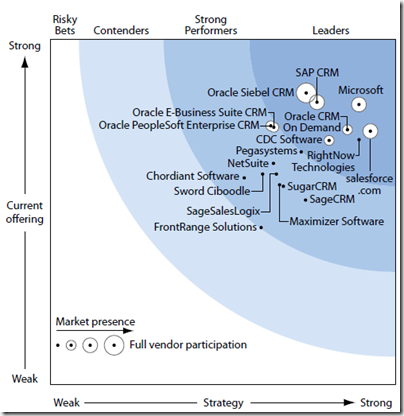
Here is the latest Forrester quadrant for large organisations Q3 2012.

So there are four horses in the race: Oracle Siebel CRM, Microsoft Dynamics CRM, SAP CRM and salesforce.com. Coming up the rear are Oracle CRM On Demand, Pegasystems and RightNow. Or are they? This is where we can get insight from the previous years.

Here is what we had in 2008 and 2010 (from the previous Forrester trajectory blog)

imageimage

So how are the leading solutions travelling?

Solution Comment
Oracle Siebel CRM They are still in the same relative position in terms of their offering but have raced forward in terms of their strategy. Ellison has been talking about a comprehensive software and hardware offering involving the cloud which may explain the move in the graphs.
Microsoft Dynamics CRM Travelling towards the top right but no major movements, just slowly improving.
SAP CRM Followed a very similar path to Oracle. Despite Ellison’s remarks in the previous link, SAP also have a cloud vision for their suite of products.
salesforce.com Comparing to the path of Dynamics CRM, we see between 2008 and 2010, salesforce edged past Microsoft in terms of their strategy, no doubt fuelled by their strong social messaging. However, Microsoft has consistently provided a stronger offering, presumably driven by their strong integration to Outlook. In the most recent graph it appears that salesforce is gaining ground in terms of their offering though.

In the last trajectory blog I suggested Oracle and SAP had lost their way. It seems they have hit back with vengeance. So the state of play is all four have strong strategic visions with, arguably, Microsoft slightly behind and all have strong offerings, with, arguably, salesforce slightly behind the pack.

As for the ‘challengers’:

Solution Comment
Oracle CRM On Demand While improving over the years, appears to be losing their strategic focus.
Pegasystems A system I had never heard of until writing this blog, they have come from, basically nowhere, gained market presence (as indicated by the circle size.) One to watch.
RightNow If we look at them, compared to the path of salesforce, we see that they have improved but have slowed in recent years and salesforce has moved far ahead. With the acquisition by Oracle, their luck may change.

Given the movement, it seems clear that the one to watch is Pegasystems.

In the previous blog I suggested Oracle’s Peoplesoft and E-Business Suite CRM products were falling behind. Both products are now well behind the pack and have, it appears, lost relevance. Perhaps this is a conscious decision by Oracle to focus on CRM On Demand and Siebel and let the others fall behind (although, according to Gartner, CRM On Demand has been replaced by Fusion). Sage has arguably done this with their CRM offerings, focussing on Sage CRM and less so on ACT! and Saleslogix and Microsoft also has, arguably, a strong focus in the ERP suites on AX and NAV and less so on GP and SL (at least, this is how it appears to me in Australia).

I also mentioned the ones to watch were CDC Software’s Pivotal, SugarCRM and Sage CRM. CDC Software appears to be slipping behind, SugarCRM has maintained its relative position and slightly increased its market presence and Sage CRM also appears to have slipped slightly.

Gartner

Here is the 2012 Gartner magic quadrant for sales force automation (I got my copy of this from the salesforce.com web site but, be warned, they will call you and try to sell you software for the privilege). You can also get it from the Microsoft News Center site (sales pitch not included). I mention this because for a social company you would think:

  • salesforce wouldn’t resort to such mundane tactics as cold calling white paper downloaders
  • given I handed across all my details and, with the world of social at their command, they might think a Microsoft CRM MVP is not their target audience

but I digress…

image

Here we have the same four horses in the top right quadrant but they are much more spread apart and ordered differently. Salesforce has moved from having the weakest offering of the four to having the strongest ability to execute. Also Oracle, Microsoft and SAP have moved from having a comparable strategic vision to being truly behind salesforce.

I am sure it is no surprise I disagree with Gartner on their belief in the completeness of salesforce’s vision. While it is true they know how to spin a good story and paint a picture or a world of social insights and meaningful customer interactions, the rash of acquisitions with little discussion of the vision for integration leaves me wanting.

In the previous trajectory article, I had five years of quadrants. For simplicity and consistency, I am again going to focus on just the quadrants for 2008 and 2010.

imageimage

For the leaders:

Solution Comment
Oracle Siebel CRM In terms of their ability to execute and their vision, they appear to be falling behind. In terms of vision, this contradicts the
Forrester report.
Microsoft Dynamics CRM Dynamics CRM has moved very fast in terms of their vision and improved slightly in regards to their ability to execute
SAP CRM While moving in the right direction, they appear to be doing it much slower than their competitors and, again, this conflicts with the Forrester report.
salesforce.com Gartner’s golden child for SFA. Relative to Dynamics CRM, it can be seen that, while moving in the right direction, Dynamics CRM appears to be catching up, although more slowly in recent years.

There are inconsistencies here between Forrester and Gartner in terms of salesforce’s strength and vision. My guess is Gartner is more enamoured with the salesforce social line than Forrester and, like salesforce, is sceptical on Oracle and SAP’s ability to deliver a social platform.

Time will tell which research house is right.

In terms of challengers, other than SugarCRM which, according to Gartner, has made massive gains on its ability to execute, there are no clear contenders. Looking at the challengers from the Forrester report:

Solution Comment
Oracle CRM On Demand Gartner believes this is no longer a competitive product in the market, being replaced by Oracle Fusion Sales.
Pegasystems Not mentioned by Gartner
RightNow Not mentioned by Gartner

In terms of market consolidation, the number of products in the magic quadrant and the number of companies has remained consistent with the numbers from 2011 suggesting consolidation of the industry has slowed or, perhaps, stopped.

As with the previous blog article, the Gartner report paints an industry with less movement of products and more stability with the leaders remaining in their dominant position. The one consistency in the two reports is who the dominant players are leading the way in the industry.

Conclusions

There are four players leading the way in the CRM industry:

  • Oracle Siebel CRM
  • Microsoft Dynamics CRM
  • SAP CRM
  • Salesforce.com

According to Forrester, all are similarly placed. According to Gartner, dominance is between saleforce.com and Dynamics CRM with salesforce the one to beat. In terms of new players, a close eye should be kept on Pegasystems. Consolidation of the industry has also appears to have slowed down. As stated in my previous piece on the Gartner trajectories, the close rivalry of the four products will only make for better, more competitive products with the winners being the consumers. It is a great time to be in the CRM game.

Saturday, July 21, 2012

Using Dialogs for Multi-Select Option Sets

Personally, I am not a fan of multi-select options sets (picklists). The reason is, generally, the response is stored as a comma-delimited text field, making reporting do-able but not elegant. The option I steer towards is multiple two value option sets (which, arguably, is also inelegant) or a child entity.

However, the requirement is something that comes up every now and again and here is a codeless solution which gets you there via dialogs.

The Dialog

Here it is:

image

In this case I am running the dialog off of the Contact record and four questions are asked, all within the same page. When answered, these are used to update the Contact record.

The Prompt and Responses

Here is the first one:

image

The only thing out of the ordinary here is me changing the Value for the Response Labels. If the answer is ‘Yes’, the value relates to the question; if it is ‘No’, I make the Value also ‘No’.

Updating the Contact

Once all of the responses have been captured, we update the contact record.

image

The Response Values defined before now populate the Description box (although any text field will be fine).

Seeing it in Action

From a contact record (we cannot run the dialog against multiple records at once, unfortunately) we select the Start Dialog button at the top

image

and select the dialog of choice.

image

This is a little awkward but can be improved with a little code and a button, if required.

The dialog opens:

image

You pick your values, close the dialog and the contact is updated.

image

Conclusions

If you need a codeless multi-select option set (and many two option fields or a child entity is not an option), this will get you there. It is also completely configurable without having to mess with jscript which, for me, is certainly a bonus.

Enjoy.

Tuesday, July 17, 2012

The Importance of Social for Support

Last month, I talked about the significance of social channels for marketing and sales. I thought it was about time to see what social means for customer support as well.

The Story So Far

For sales, I generally talk in terms of weak and strong ties. The idea being a lead is, essentially, a weak tie to another person and the sales process converts this lead to a stronger tie i.e. a trusting relationship is established. This model comes from Paul Adams, a social researcher at Facebook (formerly at Google). In this 2010 presentation he talks about three kinds of ties:

  • Temporary: someone we interact with but have no relationship with
  • Weak: someone we have a relationship with but not within our ‘circle of trust’
  • Strong: those in the ‘circle of trust’

As the presentation has over 200 slides, here is a synopsis.

Paul cites a call-center employee as a typical example of a temporary tie with the idea it is unlikely that you will interact with them more than once.

Paul also mentions that it is much easier to keep up to date with weak ties than ever before because of social networks like Facebook. However, communication with strong ties, even amongst the younger generations, involves face to face meetings and phone calls.

image

Finally, Paul says that our strong ties influence us the most in our decisions. So it makes sense, as a salesman, you want to be considered a strong tie for your customers.

How Does This Relate to Customer Support?

I recently came across this blog post by Sawan Deshpande. Being a salesforce blog, the thrust of his article is how companies must embrace the ‘social imperative’ because the youth use social networks. Here is the infographic to back up the claim thanks to the American Express Customer Service Barometer 2012.

image

The claim is in reference to the first graph. However, it is the second set of bar charts which are of more interest to me as these specifically talk about customer service and the channels preferred as the request becomes more complex. The channels move from the ‘traditional’ channels at the top (first four), down to the ‘social’ channels at the bottom (last three). They also loosely match the channels talked about in regards to the strong tie research. We can also distinguish between voice-based channels (‘real’ person and face to face) from text-based/automated communication.

Here are my takeaways:

  • As inquiries become more complex, the use of ‘traditional’ channels goes from 77% to 90%
  • As inquiries become more complex, the use of ‘social’ channels goes from 23% to 10%
  • As inquiries become more complex, voice-based communication goes from 27% to 76%
  • As inquiries become more complex, text-based/automated communication goes from 73% to 24%

To put it simply, as a query becomes complicated, people want to interact with support staff as if they are a strong tie, rather than a weak one; they want to establish a relationship with the call center representative.

As I write this I am experiencing this effect. I recently moved from a fortnightly pay cycle to a monthly one. To match this I changed my car repayment cycle. To my surprise, the repayments appeared to become a lot larger than they should. While I initially interacted with the representative via e-mail, it soon became apparent the confusion would be much more quickly resolved by using a phone. No doubt guided by company policy, the representative is resisting the move to the phone. However, if we interacted in this way, not only would I perceive the representative as more ‘involved’ in my query, it would likely get resolved more quickly and save the finance company time and money.

My experience is backed up by another piece of research from the Unified Communications End-User Productivity study which confirms that while text-based communication is good for quick ‘FAQ’-like answers, more complicated queries are often escalated to voice-based communication for resolution.

Conclusions

There is no doubt that social channels are widely used. However, just because a person uses a specific tool does not mean they want to use it for all communication. Also, it may be tempting for call centers to jump onto the social bandwagon for the purposes of cost saving but, if it is at the cost of meeting customer expectations, it is a false economy and will drive customers elsewhere.

The research backs up the notion that for a protracted query, customer prefer voice-based communication, seeking a stronger tie to the support staff, over text-based communication and automated systems.

Given traditional CRM systems are geared to track ‘traditional’ communication channels (face to face meetings, phone calls and e-mails), they align well as a tool for handling complex customer issues. In the same way that I say for sales “Social opens the door, CRM closes the deal”, we can say for support “Social opens the case, CRM resolves the issue”.

Monday, July 9, 2012

A Look at the Social Buzz of Dynamics CRM and Salesforce

In the past I have used Google Trends to review the ‘popularity’ of “Dynamics CRM” and “salesforce.com”. Given the many and varied channels for conversation out there these days, I thought I would look at some other social monitoring tools to see what story they tell. If you are looking at social monitoring and do not want to spend money, these may be worth a peek.

Google Trends

My classic favourite. You can type in any terms you like and Google will compare their popularity over time.

image

It is clear that “dynamics crm” has been catching up with “salesforce.com” over the past five years. Looking at the past 12 months, we see the catch-up is still happening but is quite slow.

image

Google Trends also tells us information about which countries, cities and languages are considering Dynamics CRM in their searching.

image

By changing the ranking, the same can be done for salesforce.com

image

Some takeaways from these are:

  • The Norwegians love Dynamics CRM (probably because salesforce does not support the language), although this does not explain the Danish and Finnish
  • The city which loves salesforce the most is San Francisco, CA (where the HQ of salesforce is located)
  • In terms of cities, Dynamics CRM is a lot more geographically spread than salesforce (salesforce is in the USA and India, in terms of cities, Dynamics CRM covers six different countries with its cities)

As you can see for searches done via Google, the feedback is comprehensive and potentially quite useful.

Social Mention

I did a piece on Social Mention late last year. Here is the update. We have “Dynamics CRM” in the first two columns, then “salesforce.com”

imageimageimageimage

Strength = Likelihood you will be mentioned in a social channel
Sentiment = Positive to negative mentions
Passion = Likelihood the same people talk about you
Reach = Measure of influence

Of the four, salesforce has a slight edge in everything but passion, which is what I discovered last year (although sentiment has also gone up for salesforce). So while a wider range of people may mention salesforce, Dynamics CRM, surprisingly, breeds the zealots.

Other things of note:

  • When people mention Dynamics CRM, they also hashtag salesforce
  • Salesforce has more association with the word ‘social’ through both keywords and hashtags (not too surprising given their marketing push)
  • Dynamics CRM has better sourcing from image sites (photobucket, picasaweb)
  • Salesforce has pixsy as a source which appears to no longer exist
  • Salesforce has more corporate-like keywords while Dynamics CRM has more development-like keywords

Topsy

A quick mention-measurer, here are the results for “Dynamics CRM” and “salesforce.com” respectively for the Twitter network.

imageimage

I have no idea why it adjusted the date ranges when I ran the queries but in all equivalent measures, other than ‘All Time’, Dynamics CRM is beating salesforce.com.

For the Google Plus network, while the numbers are smaller the story is quite different.

imageimage

Here the clear preference is for mentioning salesforce.com. In other words, it appears that “Dynamics CRM” is becoming the king of Twitter, while salesforce.com reigns supreme in Google+.

Conclusions

If you are looking for insights into keywords and the conversations being had with them, there are plenty of tools out there to get an idea on people thoughts and associations and some good ones are free. In terms of “dynamics crm” and “salesforce.com”, while the use of these specific terms is not a complete picture of how Dynamics CRM and the salesforce cloud suite of products stack up, it does give us some insights in terms of where the products are having success in the world and what associations people have with the products.

Also, there does appear to be a consistent suggestion that the “dynamics crm” term is gaining popularity over “salesforce.com” specifically in general searches and on Twitter.

Try the tools out and see what insights they give to your business. The price is right and you might discover something new.

Sunday, June 24, 2012

Traditional Marketing, Social Networks and CRM: How it All Fits Together

I just did a presentation at Decisions Spring 2012 and I thought it would be interesting to summarize the presentation here as well as it is something I feel is important, given the hype and confusion regarding social networks and social CRM at present. The exercise has also clarified some of my thinking on the subject so even if you saw the presentation, this may help you understand my perspective.

The Imperative for Change

The way we engage with vendors and engage with each other is changing. It used to be that the primary source of information for a product was the manufacturer. With the advent of the internet, information is ubiquitous. All human knowledge (or, at least, the practical and useful stuff) is now a mere URL away. Also, people who we would only see at weddings and funerals, are now a click away thanks to sites like Twitter, LinkedIn and Facebook.

This change may feel sudden but they have in fact been building up over a number of years. Back in 1999, The Cluetrain Manifesto was written which predicted that the internet would force companies to change the way they treat and interact with their customers. Classic “theses” include:

“Markets are conversations.”

“The Internet is enabling conversations among human beings that were simply not possible in the era of mass media.”

“People in networked markets have figured out that they get far better information and support from one another than from vendors.”

“Already, companies that speak in the language of the pitch, the dog-and-pony show, are no longer speaking to anyone.”

“We are immune to advertising. Just forget it.”

While it has been over ten years, these quotes are as powerful today as back then and certainly more understandable. Most of us are part of the ‘networked market’ now, we just called it ‘social’.

Push and Pull Marketing

Now we have an appreciation of where we are heading, let us reflect on where the traditional corporate conversation is. Traditionally, marketing has been divided into two categories: Push and Pull.

image

Push marketing is the convincing of a known party (a seller) to conduct a sale.

Pull marketing is the convincing of an unknown party (a consumer) to initiate a buy.

Examples of these strategies can be seen today with the partner model of Microsoft. Microsoft often offer incentive to ‘the channel’ to promote the sales of a certain product. For example, they may promote a “get a Dynamics GP license for $1” offer to the partners to encourage them to push the product.

An example of a Microsoft “pull strategy” are the inspiring adverts we have all seen telling us how Microsoft enables us to achieve more.

image

The Apple iPad advertisements are also classic examples of a pull strategy.

The Problem With the Push and Pull Model

There is a growing problem with defining advertising strategies as “push” or “pull”. The problem is it assumes an intermediary. In the case of Microsoft, the model is still valid in that there is a partner network. However, for many products, the distance between the manufacturer and the buyer is shrinking. It also assumes a largely passive seller with the buying decision being controlled through the result of actions of the manufacturer.

Let us consider the example of a used car. While advertising may pull me to choose a certain dealership, there is no push as there is, effectively, no manufacturer to profit from the sale. The push now shifts so it is between the user car salesman to the buyer. It is now the seller’s actions which promote the sale. He may, for example, promote a specific car on the lot that he wants to sell. Therefore, while in the traditional model, push was an interaction between the manufacturer and the seller and pull was an interaction between the manufacturer and the buyer, this has devolved into two types of interactions between the buyer and seller.

Let’s listen to the conversation:

Seller: You should buy this car here (push)

Buyer: I’ve been looking at online at the cars on the lot and I want you to sell me this one at the same price (pull)

Seller: Deal

Another interesting note in this interaction is that the buyer does not say where they were getting information about the cars on the lot. While, for a traditional push, it would be from the seller, with the myriad of online conversations it is not necessarily the case.

However, putting aside the social aspect for the moment, from the seller’s perspective, the push and pull strategies now become:

Push Marketing is promoting a sale with a known buyer

Pull Marketing is promoting a sale with an unknown buyer

Why Traditional CRM Systems Only Do Half the Job

Traditionally, CRM systems contain information on who you are looking to sell to, who you have sold to in the past and who you have failed to sell to in the past. In other words, CRM systems are great at holding information on known potential buyers. This means they are great for push marketing and most traditional CRM systems have a marketing module for direct marketing (the poster child for push).

Where they fall short is providing insight into unknown buyers. The best they can do is give rough guidelines of the kinds of people that may purchase based on those that have purchased in the past but they will never tell you a phone number of someone who is ready to buy at this moment. In other words, traditional CRM systems are almost useless for communicating with the unknown audience for your product.

The Problem With Pull

To make matters worse, traditional pull advertising (billboards, television etc.) is becoming less effective in that a consumer now has many sources of information, via the internet, to aid in their purchase decision. It is well and good getting an idea that your key demographic is “affluent 30-somethings” and putting a message out in the wild targeting this group but the “affluent 30-somethings” now have many other sources, all self-selected and these sources are likely to match their personal profile much better than trends generated from a database.

How Do We Make CRM Systems More Pull-Friendly?

While there is definitely value in bringing business intelligence tools to CRM to gain insights into customers, the information such tools provide us on customers we do not know about is limited. For example, let us imagine there is a new market for our product completely outside of our traditional selling space. No analysis of our known customers is going to reveal this insight. To do this, we must look elsewhere.

The good news is the ‘unknowns’ are communicating their thoughts and desires every day and in a way that we can easily access. Through social networks is it possible to read the minds of millions of people we would otherwise have no interaction with. Insights from these new conversations can be used to:

  • Generate sales leads
  • Provide insight into product innovation
  • Identify problems consumers may be having with the product
  • Gain a better understanding of competitors

Therefore to make a CRM system more pull-friendly it needs to:

  • Allow us to easily generate content to promote social conversations
  • Allow us to capture the participants of these discussions in CRM so we can establish a direct relationship with them and engage in push marketing i.e. generate a sale

Brent Leary summarized the idea well in the following diagram.

image

Why Many CRM Makers (and Their Customers) Are Still Getting it Wrong

Even the most social of CRM manufacturers do not see the complete picture. While many allow for ‘monitoring’ e.g. displaying a contact’s twitter feed on their contact record, very few allow the generation of content to promote discussion and even fewer provide a simple mechanism to capture those discussions and bring them into a traditional sales/support process.

The reason these solutions sell so well is that many companies also fail to see the big picture. According to IBM, 80% of companies have a social presence but very few have worked out how to use it for CRM. You may also hear the common complaint that it is difficult to measure the return on investment (ROI) on social marketing. The fact is, while these organisations are spending lots of money generating awareness online, they are failing to promote a call to action and therefore are generating precious little revenue from their many thousands of Facebook fans.

I am sure if I painted my face on the moon it would generate a lot of attention for me but without giving people a clear path to purchase, I will have simply spent a lot of money to make me famous, but not rich.

In fact, I only know of one product which handles the issue of pull marketing and social networks for CRM well. This product is Webfortis Parrot. I have no vested interest here, I just love the product and believe it fills the gap to make Dynamics CRM a complete push and pull solution.

Why Bringing it Into CRM is Vital

The reason it is essential that the conversation be brought in and managed through a CRM system is simple; social networks allow you to keep tabs on people but they do not make for meaningful relationships. The notion that a traditional CRM system is some kind of inferior tool for creating strong relationships is simply not true. Steven McKee recently posited this in Business Week and I fundamentally disagree with him. It is true that traditional CRM systems can be used poorly and it is also true social networks ensure all mistakes will be public knowledge within an instant but to suggest a traditional CRM is only good for one-way communication is a nonsense.

The CRM tool is only as good as the user so if a salesman is communicating poorly with their customers and using a CRM system to more efficiently manage their customers this will obviously be a more efficient path to a poor result. Conversely, if a salesperson is a good communicator and can communicate authentically, as promoted by the Cluetrain Manifesto, then a CRM tool will allow them to do this with a much larger customer base than if they were not using it.

So while it may be true that a CRM system does not, of itself, promote poor communications and poor relationships, why do we think it is better than communicating via a social network? The answer is because the research backs it up. Paul Adams, a social researcher at Facebook (formerly at Google) synthesized a mountain of academic research on the social nature of humans. Paul talks about weak and strong ties. Broadly speaking this is the difference between a friend and an acquaintance. It turns out that to communicate with strong ties, we use different channels than we do for weak ties, as shown below.

image

He goes on to say “Many people use e-mail for very private exchanges…Some young adults use e-mail to communicate with their strongest ties because their (online) social network is overloaded with information.”

The fact is, while we can generate a weak tie to someone through social networks, to create a strong tie to someone requires the use the traditional tools of communication such as a face to face meeting, a phone call, text messages and e-mail. These channels are, as confirmed by Steven McKee, the domain of CRM systems.

Steven is not alone in thinking social networks are a channel that is somehow different to other channels of communication but it is not; it is simply one channel available to establish a rapport with someone. However, in terms of generating that ‘trusted advisor’ status keenly sought by many salespeople, social happens to be one of the worst channels you can pick. In other words, social is great for generating the lead but lousy for progressing the sale.

Does All This Only Apply to B2C?

One of the themes in the questions asked of me after the presentation at Decisions was whether this was more of a topic for B2C (companies that sell to individuals) rather than B2B (companies that sell to other companies).

My personal belief is if you feel pull marketing is important to your marketing strategy and gaining insight into the unknowns is also important then there is value in employing the social channel. While the emphasis may be different, even in a B2B sale, the ultimate consumer is a person. For example, if I, as a seller, can gain insight into the desires of the employees of a company, I can present that information to the CEO (ideally in a face to face meeting) and use this information to close the deal.

If the CEO is not listening to the employees directly, it is likely the insights gained will be a revelation to him and this will go a long way towards establishing a strong tie with this key decision maker.

Conclusions

Traditionally, direct sale companies employed a sales force to establish strong ties with prospects. To reach the known potential buyers, which the sales force could not get to, push marketing was also used. To reach the unknown buyers, pull marketing was used.

Technology (CRM) allowed the sales force to better manage their client base and establish strong connections. Push marketing, in the form of direct mail campaigns continued to be employed, secure in the knowledge that it was cheaper to resell to a previous buyer than to sell to a new buyer. Pull marketing was also employed to attract new buyers, although this was managed outside of the CRM system.

With the advent of the internet and social networks, the value of traditional pull marketing (e.g. billboard advertising) was reduced as there were many sources of information on the same product from sources other than the seller. Therefore, to deal with this loss of marketing value, CRM systems need to assist in the generation of content to promote conversations on a given topic. They also need to be able to monitor these conversations and, if they are of interest, easily capture them within the CRM system so a relationship can be established with the potential, previously unknown, customer.

To establish this relationship, while communication could remain on the social network, research shows that the traditional channels of communication, such as face-to-face meetings and the telephone are more effective.

As all communication is between two people, it is often thought that social networks are of limited value in a B2B sale. However, as they give us insight into the people than make up an organization, there is still value to be had.

To date, CRM systems handle the social channel quite poorly in terms of content generation, monitoring and conversion into a CRM record. CRM manufacturers are aware of the problems and are rushing to address them, although even the most comprehensive CRM solutions are still lacking in this regard.

Monday, June 11, 2012

A Quick Bayesian Classifier For CRM

Following on from my previous article where I talk about the idea of a Bayesian filter for CRM, I did a bit of digging on the interwebs and found this Excel Bayesian Classifier. Being open source it is easy to review the VBA to see how it works (which I plan to do at some point and see if I can make a workflow version or similar).

The default example is about movie ratings but it is easy to convert this to be more ‘CRM friendly’. Here is one I prepared earlier:

image

In this example, I use three variables (one more than the example provided out of the box):

  • Value Range (this is the range an estimate for the value of the opportunity falls in to. For example, ‘Low’ may be deals worth $0-$10,000)
  • Company Type (Private or Government)
  • Relationship (How good our relationship is with the prospect)

and the results of these ‘historical opportunities’ are shown in the fourth column. We can think of this as the Closed Opportunities view entered into the spreadsheet.

The discerning eye will be able to work out the kind of deals we succeed at but, if it is not obvious (and if you are dealing with many opportunity examples it will not be) this is where our Bayesian Classifier comes in.

Predicted Results

Here are the statistical predicted outcomes for the variables in the absence of all other information.

image

In other words, we do well at the smaller deals, deals with private organisations and deals where we have a close relationship with the prospect.

We can now dump our Open Opportunities view into the first three columns and the spreadsheet will predict which ones we will win, based on the information gained from the historical ones.

image

While, in this case, the result is a prediction of whether the opportunity will be won or lost, it is also possible to return a confidence level (percentage) on the likelihood of the outcome. This would be used as our probability percentage for winning the deal.

What I really like about this spreadsheet is that it appears to allow for any number of input variables. In my case I used three but you could used more.

Strictly speaking, this is what is called a ‘naive’ classifier which means it assumes there is no relationship between the three variables. If it was such that we only went for large government deals, this assumption would not be correct and this dependence would affect the system’s ability to accurately predict the result.

So Why Are We Going To All This Effort?

I briefly outlined the reasons in my last blog but Phil Richardson, former heavy-hitter on the Microsoft CRM development team and college friend, who has recently moved into the position of Head of Baby Roasting at salesforce (not his real title), wrote an article a few years ago talking about the problems of pipeline revenue projection using a human-estimated probability. Some of the problems he references are:

  • Probability estimate usually either guessed or blindly refers to the sales stage
  • Historical success not considered
  • Historical opportunity characteristics not considered
  • Does not consider the historical success of the salesperson’s estimations

The use of a classifier addresses all of these issues in one hit.

Another option would be to use a ‘scorecard’ to score an opportunity based on predicted ‘good values’. The main problem with a scorecard system is you must determine what the good values are and you must work out how many points to assign each value. The Bayesian classifier does this automatically through the statistical calculations.

Conclusions

If you have a large volume of some kind of record in your CRM system (opportunities, leads, cases etc.) and you think that certain characteristics may govern the fate of these records (win/lose, conversion to an opportunity, routing to a specific queue etc.) download the spreadsheet, feed it some historical data and see how it goes at predicting either other historical outcomes or keep a tally on how it goes with existing records.

Sunday, June 3, 2012

My ‘Killer App’ For CRM

This is an idea I have mentioned to people from time to time. It can be applied to any extensible CRM system in the market and, in my opinion, it will eventually be an integral part of all CRM systems in the market. To my knowledge there is no CRM system doing this today.

So what is it? A configurable Bayesian filter.

What is a Bayesian Filter?

Many of us, directly or indirectly, use a Bayesian filter every day. Many spam filters rely on this technique. Essentially, a Bayesian filter uses past evidence of a number of situations to assess whether a current situation is a match. In the case of e-mail, the filter generally has a collection of ‘good’ e-mails (ham) and ‘bad’ e-mails (spam). By keeping a track of the words in those e-mails, it employs statistics to work out the probability whether a new e-mail is ‘ham’ or ‘spam’.

The unusual name comes from a mathematician called Thomas Bayes who formulated a specific case of the theorem used to run such filters. As is often the case in mathematics, the theory came first and the application came a lot later (in this case about 250 years later).

How Does It Apply to CRM?

Let us consider the bread and butter of CRM: sales force automation. Let us assume we have a large volume of sales opportunities going through CRM. Some of these opportunities are won and some are lost. Generally, while they are in the process of being won or lost, they are assigned a probability to help with predicting future revenues.

In the case of sales opportunities our filter will review all historical opportunities that were won (ham) and those that were lost (spam). It could then look at the fields on the opportunity record and associated customer record and, based on these, assign a  probability of success to all opportunities in the pipeline.

Not only do we eliminate the eternal problem of traditionally optimistic salespeople manually assigning probabilities which may or may not reflect reality but we may also gain insight into where our business is successful e.g. is there a certain industry where we do particularly well?

What Other Applications Are There?

Let’s say we have strong integration to our communication channels e.g. e-mail, twitter etc. Let us also assume we have the ability to convert this communication into ‘CRM stuff’ e.g. sales leads, opportunities, support tickets/cases etc. We, again, have an opportunity to apply our filter. In the case of Dynamics CRM, from Outlook, we can, at the click of a button, turn this into a sales opportunity or case. Our filter can look at all historical conversions and, based on the content of the e-mails, consider whether new e-mails should be automatically converted or not. Another application may be the automatic creation of cases and auto-routing them to the right queue, based on how previous e-mails had been routed and queued.

Why Will This Be More Important In The Future?

Firstly, as CRM use matures, businesses will be capturing more and more structured data and will want to analyse it for insights into their business. This tool allows us to review certain historical data and derive insights for our present situation.

Secondly, as social channels become more important, we will need a way to efficiently filter the ‘wheat from the chaff’. One of the skills one must learn when using Facebook is the skill of not caring if you do not read every single update in your feed. I personal struggle with the idea that I may have missed ‘the one really important update’. In the case of Facebook, the chance of an important update is vanishingly small but, for business trying to monitor the massive volumes of social data, the consequence of missing a key opportunity or complaint is much more costly making an ‘intelligent filter’ increasingly more vital.

Conclusions

So there is my one ‘killer app’ for CRM. If you plan to implement this, I am sure we can come to an arrangement on my cut of the waterfalls of cash that will flow from it. Ultimately though, I am keen to see it ‘in the wild’ because it opens up a world of possibilities for CRM beyond the simple capturing of data in a central location, which is very exciting.